Think about the last thing you handed a client at closing. A bottle of wine, a cutting board engraved with the new address, a basket from the local bakery. Your clients loved it. A few months later it's been used up, passed along or tucked in a drawer, and your name went with it.
That matters, because your next deal will most likely come from someone you already know. In NAR's 2024 profile of buyers and sellers, 66 percent of recent sellers used an agent who was referred to them or one they'd worked with before.
A home inventory gets opened when your client needs it: the dishwasher dies and they want the model number, the insurance company asks what was in the garage, or they're getting ready to move again. And you can give one to every client, buyer or seller, in the week it helps them most.

Move-out: your sellers
Your sellers have probably been in that house a while. NAR's 2025 profile puts the typical seller's time in their home at 11 years, an all-time high. In 11 years a garage fills up, a guest room turns into storage, and nobody remembers what's in the boxes in the attic.
Packing brings all of it out. Every item gets picked up and wrapped anyway, so a few photos of each room before it's boxed up cost almost nothing. If the movers drop the TV or a box never arrives, those photos are what the moving company will ask for.
It also fits the work you're already doing together. When you talk about decluttering for listing photos and staging, your sellers are already sorting into keep, sell and donate. An inventory turns that sorting into a list they can use when they unpack at the other end.
For the packing itself, our moving guide walks through it step by step.
Move-in: your buyers
Move-in is the same week in reverse. Every box gets opened and everything finds a new spot, so your buyers are already handling the things worth writing down.
The timing matters for insurance, too. Most buyers set up a homeowner's policy before closing, and the amount of contents coverage is usually an educated guess. A room-by-room list with values shows whether the guess was close, and if they ever file a claim, it's the proof of ownership the insurer will ask for.
The house also came with things of its own: the fridge, the washer and dryer, the water heater, the furnace. The first week is when the manuals are still on the counter and the model and serial numbers are easy to photograph, well before anyone needs them for a repair or a warranty.
How to give it
- Sellers: at the listing appointment. Packing starts weeks before closing, and the photos are most useful before the first box is taped.
- Buyers: at closing, or on move-in day with the keys.
- Keep it to a sentence or two. Something like: "Take a few photos of each room as you unpack and you'll have a record of everything in your new home. Your first year is on me."
- Point them to one room. Whichever room they're unpacking first is a good place to start. After that, the rest tends to follow.
Make it part of your annual check-in
Closing isn't the last time you'll talk. Plenty of agents send past clients a yearly update on what their home is worth and what the local market did. Ten Tenths, the coaching company behind the Life at Ten Tenths podcast, builds this into its Market Impact Reports, branded annual client updates with local data.
That visit is a good time to talk about Homvi too. The report tells your client what the house is worth, and their Homvi shows what's inside it: the new couch, the patio set, the boxes from the garage they finally unpacked. Your Homvi Pro dashboard shows you when each client's year is coming up, so you know who's due for a check-in. What happens next is up to you. You can sponsor another year, or let your client carry on with Homvi on their own. Either way, they keep everything they've documented.
What it looks like
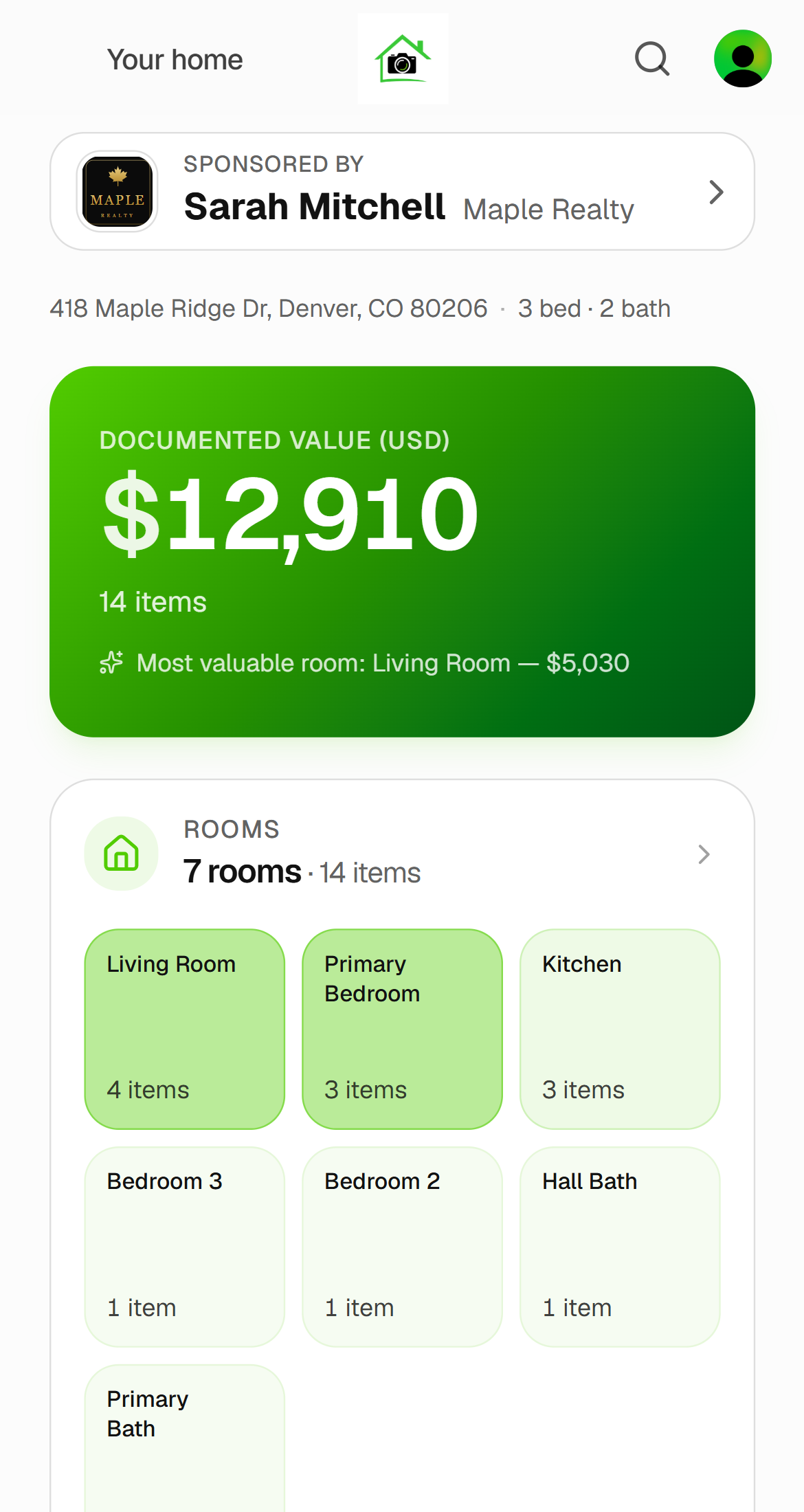
Here's what your client sees, using a sample agent, Sarah Mitchell of Maple Realty, rather than a real client. When you give a year of Homvi, your name appears at the top of their home screen:
Tapping it opens your card, with Call, Text and Email:
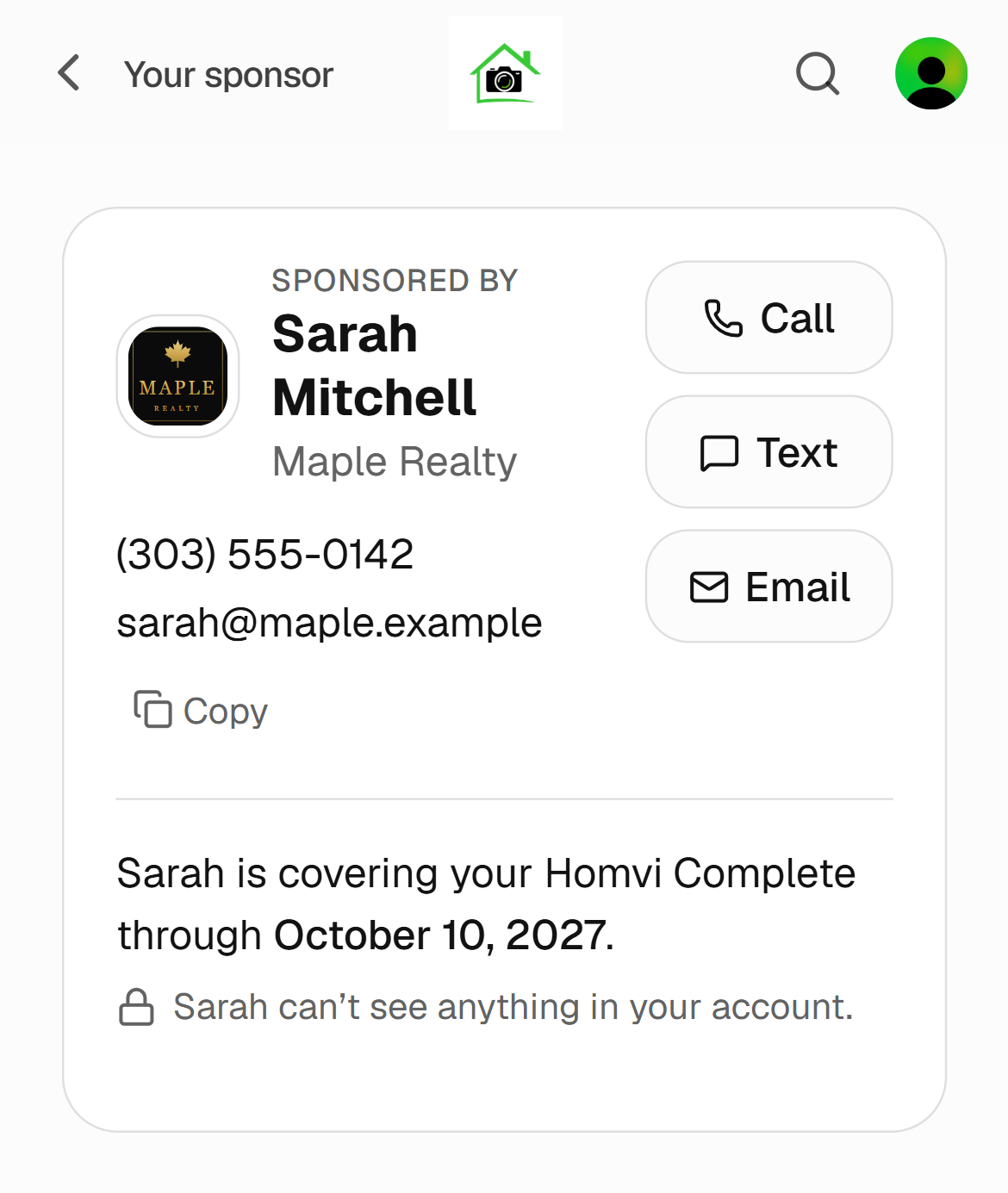
You never see what's in their home, what it's worth or their photos. You see whether they've signed up and when their year ends.
Where Homvi fits
Homvi turns photos of each room into a list of what's in it, with each item named and given an estimated value. Your client keeps it on their phone and takes it with them to the next home.
With Homvi Pro, you give each client a year of Homvi with your name on it, whether they're packing up or moving in. Your first client is included, and the year is already paid for, so your client never sees a bill.